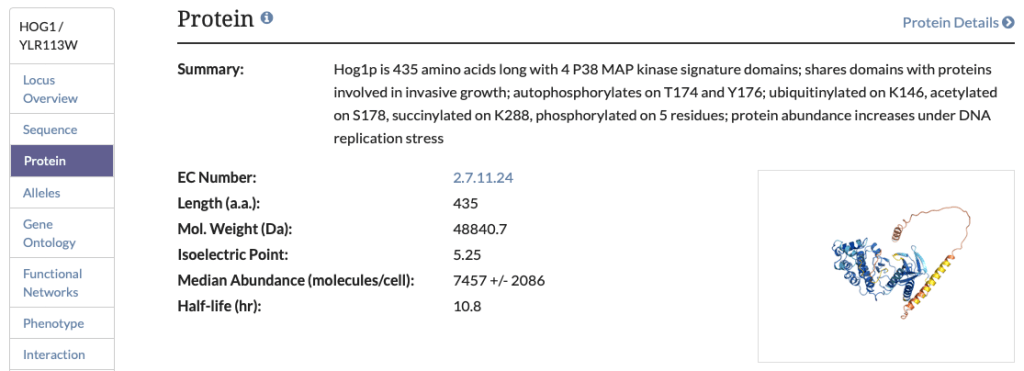
We’ve updated the Protein section of SGD gene pages. It now shows a gene’s Enzyme Commission (EC) number, where one is assigned, and a thumbnail of its AlphaFold predicted structure. Both give you more protein information at a glance and lead to the full details.
What’s new
The Protein section already gave basic sequence-derived information (length, molecular weight, and isoelectric point) and experimentally determined information (median abundance and median absolute deviation). We’ve added two things:
-
EC numbers. If a gene product has an assigned EC number, it now appears in the Protein section. The number classifies the reaction the enzyme catalyzes. Genes without an assigned EC number show no EC field. On the HOG1 page, for example, the mitogen-activated protein kinase is listed with EC 2.7.11.24, which links out to the ExPASy ENZYME database.
-
AlphaFold structure thumbnails. A static image of the protein’s AlphaFold predicted structure now appears in the section. These are computational predictions, not experimentally determined structures.
About AlphaFold
AlphaFold, developed by DeepMind, is an AI program that predicts protein structures from amino acid sequences. This lets you visualize protein conformations. The predicted structures can be accessed through the AlphaFold Protein Structure Database and are also available through PDB partner resources.
Explore the details
Click the Protein Details link or the AlphaFold thumbnail to open the gene’s full protein page. The thumbnail is a static image. On the details page, AlphaFold’s interactive viewer lets you explore the predicted structure. The page also includes:
-
Half-life
-
Abundance
-
Domains
-
Domains shared with other proteins
-
Protein sequence retrieval for various strains
-
Physico-chemical properties
-
Protein modification sites
-
External identifiers for the protein
Why it matters
The EC number shows at a glance what type of reaction an enzyme catalyzes. The thumbnail gives a first look at a predicted fold, and the interactive viewer on the details page lets you examine it more closely. The Protein details page also puts abundance and half-life measurements, domains, modification sites, and external identifiers in one place.
Try it out
Go to any gene page, such as HOG1, scroll to down to the Protein section, and click the AlphaFold thumbnail or the Protein Detailslink.
Questions or suggestions? Contact us!