We’re excited to announce new Functional Networks sections on gene and complex pages at SGD! This powerful addition helps researchers understand how genes and proteins work together in biological systems.
What Are Functional Networks?
The new Functional Networks section appears on most gene page, positioned just below the Gene Ontology section. It provides two complementary views of how gene products interact and function together:
1. Shared Annotations Networks
Ever wondered which other genes might have similar functions to your gene of interest? The Shared Annotations network visualizes genes that share similar Gene Ontology (GO) annotations with your query gene. These networks are generated based on overlapping GO terms across Molecular Function, Biological Process, and Cellular Component.
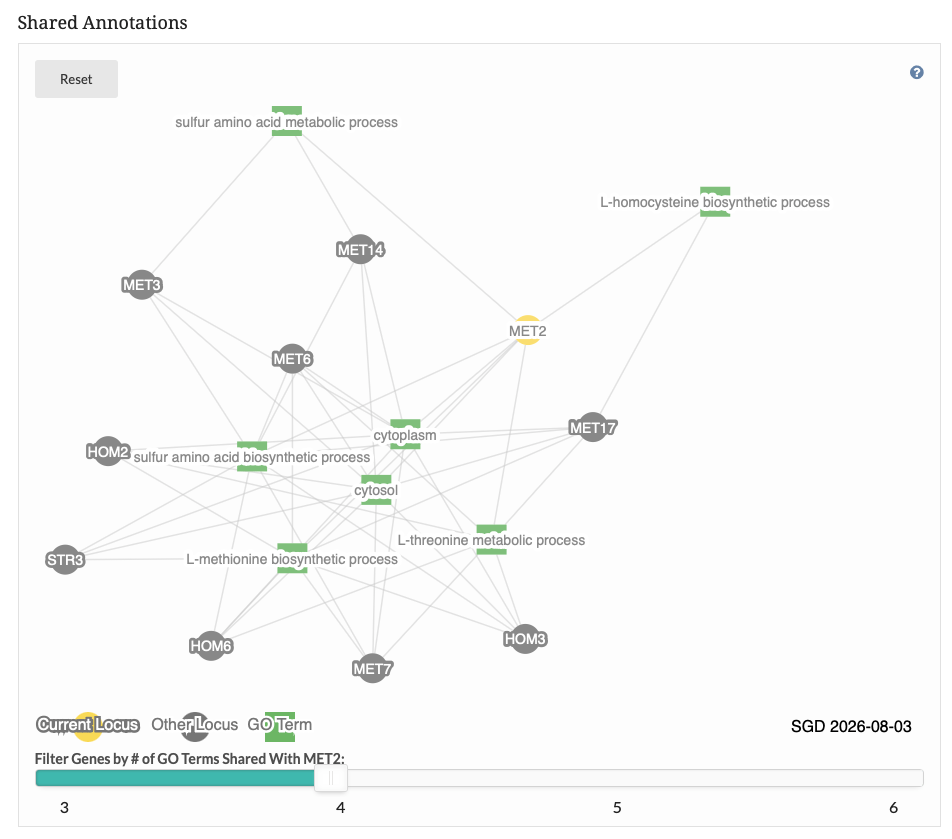
Why is this useful?
-
Identify potential interaction partners
-
Find paralogs with related functions
-
Discover genes that may participate in similar biological processes
-
Generate hypotheses for experimental design
Most genes in the S. cerevisiae genome have sufficient GO annotations to generate these networks, providing broad coverage across the yeast proteome.
2. GO-CAM Pathway Models
GO-CAMs (Gene Ontology Causal Activity Models) represent an exciting advancement in pathway representation. Unlike traditional GO annotations that link individual genes to single terms, GO-CAMs show how multiple gene products work together in integrated pathway models.
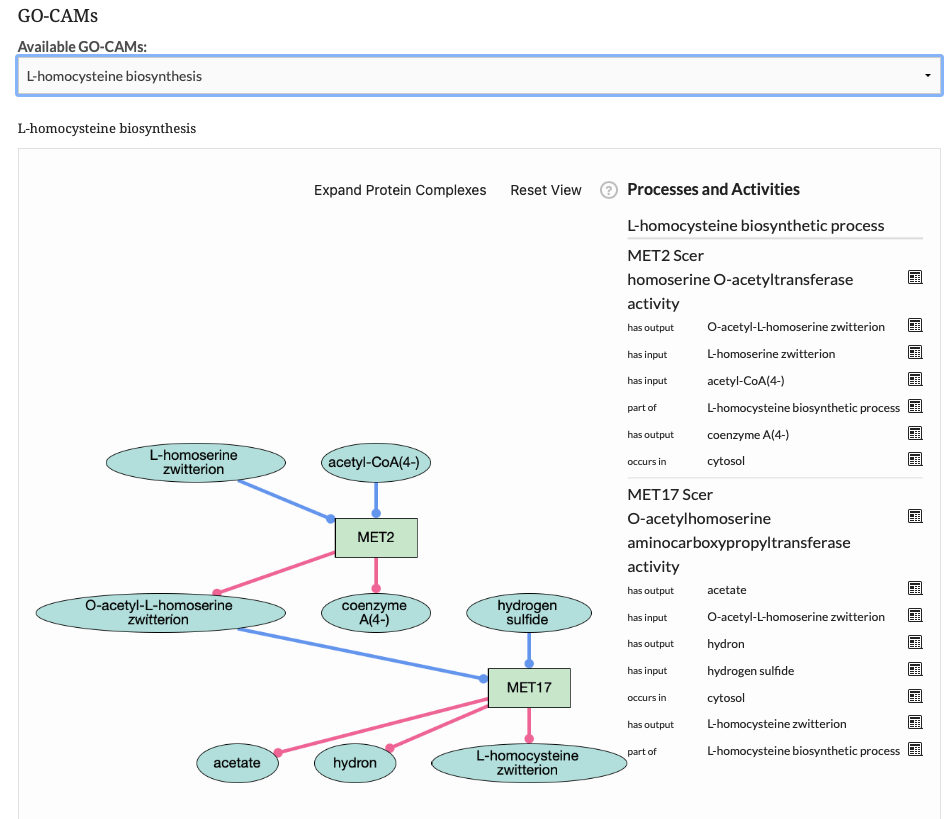
What makes GO-CAMs special?
-
Causal relationships: See how one molecular activity leads to another, including activation, inhibition, and regulatory interactions
-
Integrated view: Combines Molecular Function, Biological Process, and Cellular Component information in one unified model
-
Evidence-based: All models are manually curated by expert biologists and supported by published experimental data
Currently, 470 yeast genes are associated with GO-CAM models, and this number continues to grow as additional pathways are curated.
When multiple GO-CAM models are available for a gene, you can easily switch between them using a pull-down menu. Each model includes a “View GO-CAM at Gene Ontology” link that opens the interactive pathway in AmiGO, where you can explore detailed evidence codes, supporting references, and connections to other pathways.
Functional Networks on Complex Pages
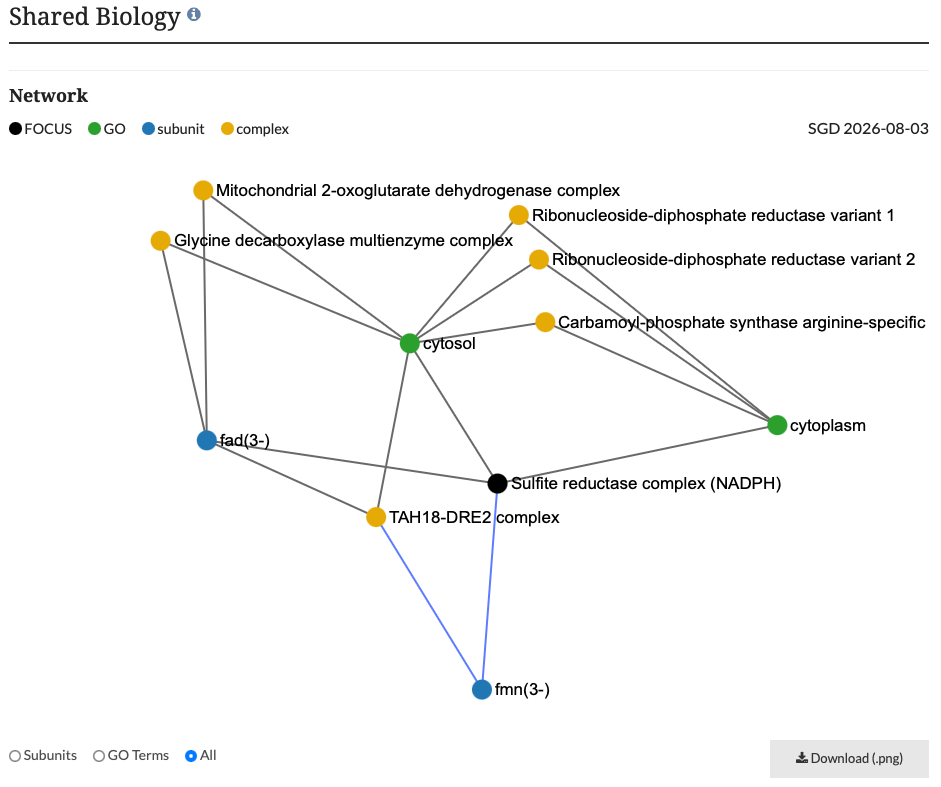
We’ve also added a Shared Biology section to macromolecular complex pages. This section shows:
-
GO annotations shared with other complexes
-
Subunits shared between complexes
-
A ranked list summarizing these relationships
This helps researchers understand how protein complexes relate to each other and identify functionally similar complexes.
How to Access
Simply navigate to any gene page at SGD and scroll to the Functional Networks section (located beneath Gene Ontology). For complex pages, look for the Shared Biology section.
Try it out:
-
Example gene page: https://www.yeastgenome.org/locus/MET2
-
Example complex page: https://www.yeastgenome.org/complex/CPX-3163
Part of a Bigger Picture
The GO-CAM display on SGD gene pages replicates the implementation from the Alliance of Genome Resources, providing a consistent user experience across model organism databases. This integration reflects our commitment to making yeast data accessible and interoperable with other genomic resources.
We Want Your Feedback!
This new feature is designed to help you explore gene relationships and generate hypotheses more effectively. We’d love to hear what you think! Contact us at sgd-helpdesk@lists.stanford.edu with your feedback or questions.